 I’ve often wondered why laws against cannabis were introduced in South Africa, where Cannabis sativa L. is an indigenous plant. It never made much sense.
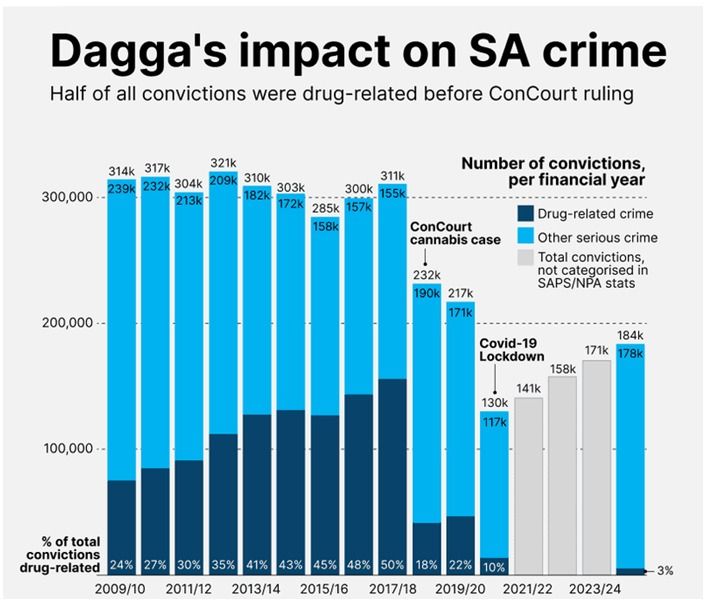
A graph produced by The Outlier for GroundUp, tracing figures back to 2009/2010, makes it clear just how much time and money has been spent prosecuting “offenders” and incarcerating them over a plant rooted deep in the region’s history.
Racism and moral panic
I had an idea that race would play a part in the story behind cannabis criminalisation. And as a Verwoerd era child, I was programmed to see everything through a racial lens.
But I never realised how foundational the opposition to cannabis was, and how we have stil;l not quite sorted out how to deal with the dagga issue.
WE know, around the world, cannabis was prohibited through a mix of moral panic, racism, political lobbying, and economic interests, rather than clear scientific evidence of uniquely dangerous harm. In many countries, these early restrictions were then copied into later drug‑control treaties and national laws, which is why so many places ended up with similar bans.
Why was cannabis prohibited around the world?
The Marijuana Tax Act in the USA
I don’t want to dive deeply into the United States’ complex drug history, but early cannabis laws there were driven by fears of Mexican and Black communities, especially after Mexican immigrants brought recreational use into the Southwest.
Officials and the media pushed sensational stories linking cannabis to violence, madness, and moral decay, which helped justify strict controls and the 1937 Marijuana Tax Act—an effective federal ban packaged as a tax measure.
 Dagga laws in South Africa
In South Africa, cannabis (dagga/intsangu) was already widely used in traditional and rural communities. Some frontier medical reports from the 19th and early 20th centuries describe Boer and British‑trained doctors recommending cannabis‑based tinctures or teas for high blood pressure, insomnia, and chronic pain, showing that dagga‑derived medicines briefly entered settler medical practice before being pushed out by later prohibition laws.
But colonial and later apartheid‑era governments criminalised it under laws like the Medical, Dental and Pharmacy Act, 1928, which classified cannabis as a “habit‑forming drug” and banned its production, sale, and use. Botanists generally treat all traditional “dagga” and hemp‑type plants in South Africa as belonging to a single, polymorphic species, Cannabis sativa L., even though informal labels such as “Transkei Gold” or “Mpondo Gold” are used for local landraces.
Stick and Stones
Harry Anslinger (USA): As the first Commissioner of the U.S. Federal Bureau of Narcotics, Anslinger led a highly public, racist‑tinged anti‑cannabis campaign and was instrumental in passing the 1937 Marijuana Tax Act that effectively outlawed cannabis.
Anslinger claimed marijuana made “darkies think they’re as good as white men,” linking it to Black jazz musicians creating “satanic” rhythms.
He alleged “colored students at the University of Minnesota [were] partying with (white) female students, smoking [marijuana] and getting their sympathy with stories of racial persecution. Result: pregnancy,” and warned of Black men giving syphilis to white girls under its influence
The attitude and racism weren’t much better here in South Africa:
- Colonial and apartheid policymakers (South Africa): Officials framed dagga as a “degenerate” or “African” habit, using prohibition to control Black and working‑class communities while ignoring traditional and medical uses.
- International treaty bodies and pharmaceutical companies: Later, global drug‑control treaties (pushed by Western powers) and industry interests helped cement prohibition worldwide, often at the expense of older medicinal uses.
Cannabis prohibition in South Africa
Cannabis prohibition in South Africa began with provincial restrictions in the late 19th century and solidified nationally in 1922. The laws were driven by racial control, moral panic, and efforts to protect “white society” from substances associated with Black and Indian populations.
These measures aimed to curb consumption among non‑white workers, preserve labour productivity, and reinforce racial segregation.
Early provincial bans in South Africa
Restrictions began in 1870 with Natal’s Coolie Law Consolidation, which targeted Indian labourers’ use of cannabis (dagga). The “Coolie Law Consolidation” (Law No. 2 of 1870) tightened state control over indentured Indian workers (“coolies”) and, in the process, began restricting their everyday cultural practices, including the use of dagga (cannabis). In effect, this law helped establish the legal and racist background that allowed the state to treat dagga as a “coolie habit” to be stamped out, paving the way for the even stricter cannabis control in the 1928 Medical, Dental and Pharmacy Act.
The Cape Colony followed in 1891 with the Medical and Pharmacy Act, classifying cannabis as a poison, while Transvaal and other territories regarded it as a noxious weed. These steps collectively framed dagga as a threat to “white purity,” urban order, and worker discipline amid rapid urbanisation.
Customs and Excises Duty Act – criminalising possession
In 1922, the Customs and Excises Duty Act criminalised possession, use, cultivation, and sale nationwide, shifting the burden of proof to the accused—unlike alcohol laws. This was reinforced in 1928 by the Medical, Dental and Pharmacy Act, passed for “political and moral reasons,” influenced by South Africa’s push at the League of Nations to include dagga in global narcotics lists.
Racist fears of dagga – threat to “white purity”
Laws stemmed from racist fears: dagga was linked to Black Africans, Indians, and poor communities, seen as threats to white purity, urban order, and worker discipline. Pseudo‑scientific reports, like the 1951–1952 Inter‑Departmental Committee on Dagga Abuse, fuelled the intensification of repression and helped lay the groundwork for the 1971 Abuse of Dependence‑Producing Substances and Rehabilitation Centres Act, which effectively banned cannabis across South Africa (including the homelands) and led to mass arrests, largely of Black men.
The Inter‑Departmental Committee framed dagga use as a “special social problem” and pushed the country toward much harsher cannabis prohibition, especially under apartheid. It recommended that police target the “source” of cannabis, leading to the creation of special “dagga squads” that raided and destroyed rural crops, especially in Black communities.
The 1937 Weeds Act – criminalising plants in the ground
Another major effort to restrict cannabis came with the 1937 Weeds Act (Act 42 of 1937), which enabled property‑based enforcement. The Act classified cannabis (dagga) as a “weed” and made landowners legally responsible for preventing it from growing on their property. If plants were found, the state could remove them at the owner’s expense.
The Weeds Act helped turn cannabis from a broadly controlled substance into a rural‑policing target, empowering officials to conduct raids and crop‑eradication drives, especially in Black and African communities. In this way, the plant itself—or anyone whose land it grew on—could be treated as a criminal threat.
In South Africa two formidable women fought tirelessly for the decriminalisation of marijana,
Frances Ames and Helen Suzman
Professor Frances Ames and Helen Suzman, legendary upposition parliamentarian, collaborated as two of South Africa’s earliest, high‑profile advocates for the decriminalisation of cannabis, combining medical‑rights and human‑rights arguments against the country’s harsh drug laws. Their collaboration was not a formal organisation, but a shared public stance and correspondence that challenged the National Party’s prohibitionist approach and later tested reform possibilities under the post‑1994 ANC government.
Both women were “mavericks” in their fields: Ames as a UCT neurologist and psychiatrist, and Suzman as a long‑serving Progressive Party MP. They respected each other as veteran risk‑takers and confided in their shared frustration that cannabis decriminalisation was such an “unpopular cause” among their peers.

Frances Ames
Frances Rix Ames (20 April 1920 – 11 November 2002) was a South African neurologist, psychiatrist, and human rights activist, best known for her work on medical ethics, especially in the Steve Biko case, and for her early advocacy for cannabis decriminalisation. She worked at the University of Cape Town’s Medical School and led the neurological department at Groote Schuur Hospital, later teaching at Valkenberg and Alexandra Hospital into retirement.
As a neurologist and psychiatrist, Ames saw cannabis prohibition as an obstacle to good medicine and argued that the plant had legitimate medical and neurological uses that were being blocked by draconian laws. She rejected tight medical‑only restrictions, insisting that cannabis should be more widely available, including for social use, and publicly pleaded with the government to decriminalise it because it was an “unpopular cause” among her peers.

Helen Suzman
Helen Suzman, the long‑serving Progressive Party MP, opposed the harsh 1971 drug law that imposed mandatory prison sentences for cannabis possession and called it “the harshest drugs law in the world.” She condemned cannabis prohibition as rooted in irrational prejudice and racism, warning that it would criminalise Black South Africans and experimenting youth and fill jails with people punished for a cultural habit rather than a serious crime.
In short, both women framed cannabis prohibition as a human‑rights and good‑governance issue: Ames focused on medical freedom and scientific sense, while Suzman emphasised justice, racial equity, and the dangers of punitive, race‑loaded law.
The 2018 Constitutional Court judgment – the “grey area”
The 2018 Constitutional Court ruling (often called the “ConCourt judgment”), which decriminalised the private use and cultivation of cannabis (“dagga”) by adults, has fundamentally altered the landscape of drug‑related crime statistics in South Africa. While arrests for small‑scale possession have dropped, the illicit, large‑scale dealing of dagga remains illegal, with significant police seizures continuing.
Plummeting drug convictions
Drug‑related convictions dropped from 156,158 in 2017/18 to just 5,575 in 2024/25, according to the National Prosecuting Authority (NPA). This shows that the 2018 ruling successfully diverted thousands of minor possession cases away from the criminal justice system.
Organised crime and dealing
Large‑scale commercial dagga trade remains illegal and continues to fuel organised criminal networks. Huge quantities are still confiscated, with police reporting high‑value busts such as a R1 million seizure in Limpopo in February 2026 and a R350,000 bust in March 2026.

 Living the High Life in a Grey Zone
So for now, we are in a grey zone, living the high life: dagga shops all over the place, and legislation still churning through the law‑making machine.
Cannabis is no longer a crime to grow or smoke in private, yet the line between legal and illegal, medicinal and criminal, remains blurry—and politically contested.